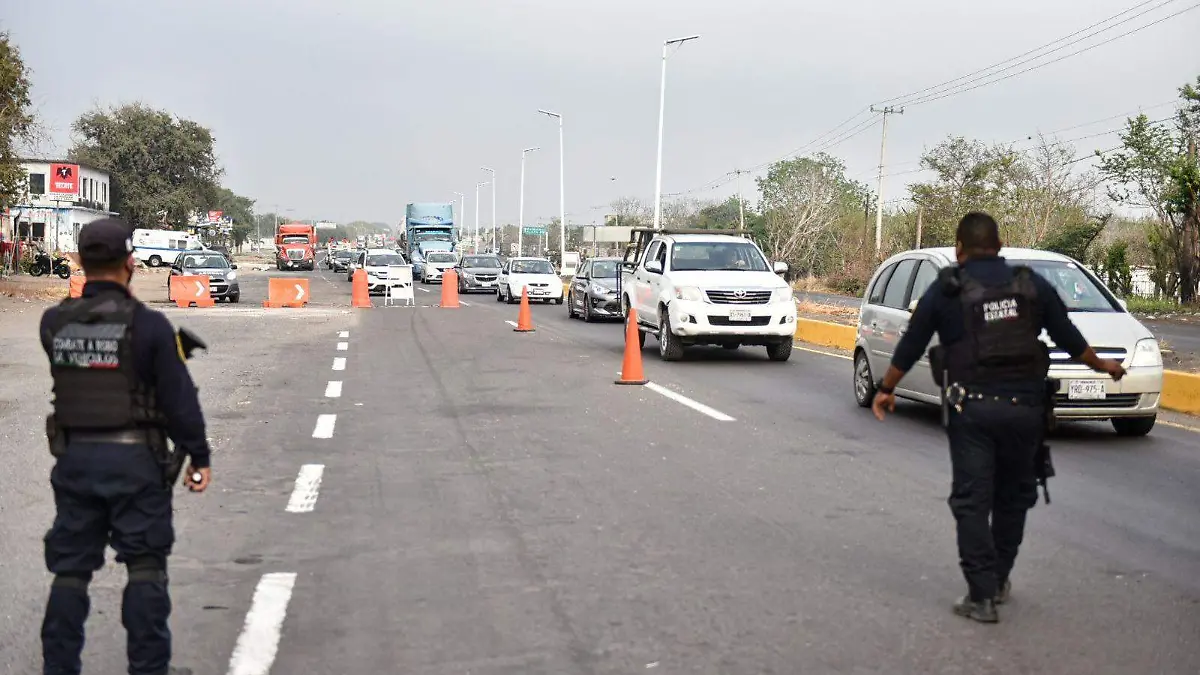
Following the road blockades in several areas of Veracruz, business owners and truckers urged the government to address the insecurity on the roads to prevent shortages of goods. They also asked the public to stay indoors, follow the instructions of the authorities, and rejected any form of violence.
When asked about the violence that erupted in the country and in Veracruz after the arrest and death of Nemesio Oseguera Cervantes, alias “El Mencho,” in an operation by the Army Special Forces, which triggered blockades in various regions, leaders of the private sector expressed their position.
Joaquín Gómez Fernández, state sub-delegate of the Mexican Alliance of Transportation Organizations (AMOTAC), stated that the situation is critical for some six thousand truckers who stopped operating in the state on Sunday after receiving instructions to stay indoors.
He specified that the most problematic areas were located on the Orizaba-Maltrata highway (the road to Puebla), as well as in the areas of Cosamaloapan, Poza Rica, and Tuxpan, among others. “Everything is complicated. We have between six and seven fires in that area. What we are doing is asking our truckers to take shelter; they are stopping, they are not driving,” he explained.
He indicated that those already on their routes have been asked to find safe places. “Although there is no place that is completely safe, at least they are trying to take cover somewhere,” he added. On behalf of AMOTAC, he demanded that all three levels of government work to guarantee safety: “The instruction from our national leader is to take shelter and not take risks.”
Bernardo Martínez Ríos, president of the Xalapa Metropolitan Business Council (CEMX), an organization that includes chambers of commerce, associations, and professional organizations in the region, stated: “The blockades in Veracruz and throughout the country are a consequence of the arrest by the Federal Government of the leader of the Jalisco New Generation Cartel.”
He acknowledged the operation as a firm action by the Mexican State against criminal organizations; however, he added: “The violent reaction demonstrates the operational capacity and territorial expansion of these groups, which necessitates total coordination between federal, state, and municipal forces to quickly restore order.”
He emphasized that every hour of blockade impacts the transport of goods, supplies, and economic stability. “We urge the public to remain calm and only heed official information. Patience is required while the authorities consolidate their strategy. Containing the violence is urgent, but consolidating a lasting peace is the true objective.”
For his part, the president of the National Chamber of Commerce and Tourism Services (Canaco-Servytur) Xalapa, Luis Francisco Llera Hernández, recommended that the public avoid areas with roadblocks or burning vehicles. He also asked people to limit non-essential travel, report emergencies to 911, and, in the case of tourist areas, recommended that visitors remain in their hotels until further notice.
“It is essential to pay attention to what the authorities announce on their official websites,” he stated.
Blanca Esther Hernández Pozos, president of the National Chamber of the Transformation Industry (Canacintra-Xalapa), expressed that any demonstration of discontent will always be reprehensible if it is carried out with violence, and urged the public to follow the recommendations for staying home.
Finally, Miguel Hernández Díaz, national advisor for Canacintra, commented that the situation on Sunday was extremely complex. “We support the Armed Forces and the Federal Government for their actions in apprehending the criminal.”
Read again: Racing Veracruz matches suspended after violent incidents in Boca del Río; Attorney General’s Office opens investigation
Arturo Blanco Hernández, president of the Employers’ Confederation of the Mexican Republic (Coparmex-Xalapa), acknowledged the work of the Armed Forces, the Security Cabinet, and all three levels of government for the actions taken in defense of the rule of law.
He requested that the population be protected and that roads, highways, businesses, and establishments that allow for mobility, trade, and economic activity in the region be kept secure.
Source: oem