
“We walk on a cemetery, unknowingly stepping on our children.” This phrase, echoed in the report Names Without Bodies and Bodies Without Names, encapsulates the human impact of a crisis that has taken root in specific territories. Sonora and Veracruz top this map, with figures that place both states as national epicenters of disappearances and the discovery of clandestine graves, according to the analysis by Causa en Común.
In Sonora, governed by Alfonso Durazo, official records jumped from 240 missing persons in 2023 to 721 in 2024, an increase of over 200 percentage points. The report identified the state as having the fastest-growing rate in the country, with cases tripling in just twelve months.
Note: The National Registry of Missing and Unlocated Persons (RNPDNO) is the only official source for obtaining statistical data on disappearances.
This escalation was compounded by the territorial dimension. In Sonora, 298 clandestine graves have been documented, and 578 bodies have been exhumed—two of the highest figures nationwide. The organization warned that “the discovery of clandestine graves has become a recurring event in recent years,” a trend that in states like Sonora is reflected in constant records.
The border state also has one of the highest rates of disappearances per capita, with 80 cases per 100,000 inhabitants, the third highest in the country, behind only Zacatecas and Tamaulipas.
In Veracruz, governed by Rocío Nahle, the scale of the problem is explained by historical accumulation. The report identified the state as having the highest number of clandestine graves in the country, with 668 recorded. This figure represents 12 percent of the national total, meaning that one in ten illegal excavations documented in Mexico since 2006 are located in this state.
35 percent of the cases have identifying information. This figure makes this state a key point on the search map, not only because of the mass graves, but also because of what they conceal. The document specified that 226 bodies have been exhumed in this territory during the analyzed period, which corresponds to 4.8 percent of the national total.
Querétaro also appears as a recent hotspot in this crisis. The report documented a 117 percentage point increase in disappearances between 2023 and 2024, the fourth highest increase in the country. The state, which for years remained on the margins of the main indicators, now shows an upward trend that places it on the alert map.
The expansion is also observed in population terms. Querétaro registered a rate of 14 disappearances per 100,000 inhabitants, confirming that this crisis is not only concentrated in specific areas but is spreading to regions with different dynamics.
In Puebla, the recent increase is reflected both in the percentage rise and in the volume of accumulated cases. The Causa en Común report placed the state among those that registered a 102 percent increase in disappearances between 2023 and 2024, the fifth highest in the country. This increase coincided with a trend that, according to official records, does not show a sustained decrease but rather fluctuations with increasingly higher peaks.
At the operational level, the recent figures confirmed the pressure on the authorities. In 2024, Puebla surpassed 1,900 disappearances under open investigation, the highest number in the last five years, while in 2025 the number remained above 1,700, with 214 people still missing at the end of the year.
In addition, Mexico City also showed significant increases in densely populated areas. Boroughs like Iztapalapa went from 75 cases in 2023 to 318 the following year, while in Cuauhtémoc the number rose from 65 to 230 disappearances during the same period. The report linked these increases to factors such as urban density and high mobility, conditions that amplify exposure to risk in metropolitan environments.
Nationally, the crisis reached unprecedented levels. Mexico ended 2024 with 13,449 missing persons, the highest annual figure in a decade, representing a 30 percentage point increase compared to the previous year. The report placed the accelerated growth of this crisis over the last 18 years, with nine out of every ten total cases concentrated in this period.
The annual trend showed a clear trajectory across presidential terms. The document distinguished three stages of the crisis: a cycle of increases from 2006 to 2011; a phase of stability until 2015; and a subsequent period characterized by constant increases that broke historical highs until 2024.
During Andrés Manuel López Obrador’s six-year term, the phenomenon reached its peak. The report tallied 53,261 disappearances, equivalent to 25 cases per day, representing a 64 percent increase compared to the previous six-year term and 215 percentage points higher than that of Felipe Calderón. Causa en Común emphasized that the former president’s administration accounted for four out of every ten cases reported in the last three administrations.
The sustained growth of this crisis also impacted the profile of the victims. The report documented that, between 2006 and 2024, 23,626 women and 14,316 minors disappeared, two groups that have accounted for a growing share of the crisis in recent years.
Official figures showed that, in 2024, disappearances of women increased by 54 percent, while those of minors grew by 76 percentage points compared to the previous year. The document warned that the profile of these victims “is diverse, in line with a multiplicity of forms of violence,” which broadens the scope of the phenomenon beyond a single criminal pattern.
The organization linked the growth of this crisis to structural factors. It noted that the disappearance of people “has reached an enormous magnitude” associated with the expansion of crime and describes it as “a widespread practice of terror among criminal organizations.”
The report concluded that “the disappearance of people in Mexico maintains an upward trajectory that deepens over time, with no signs of abating in the short term.”
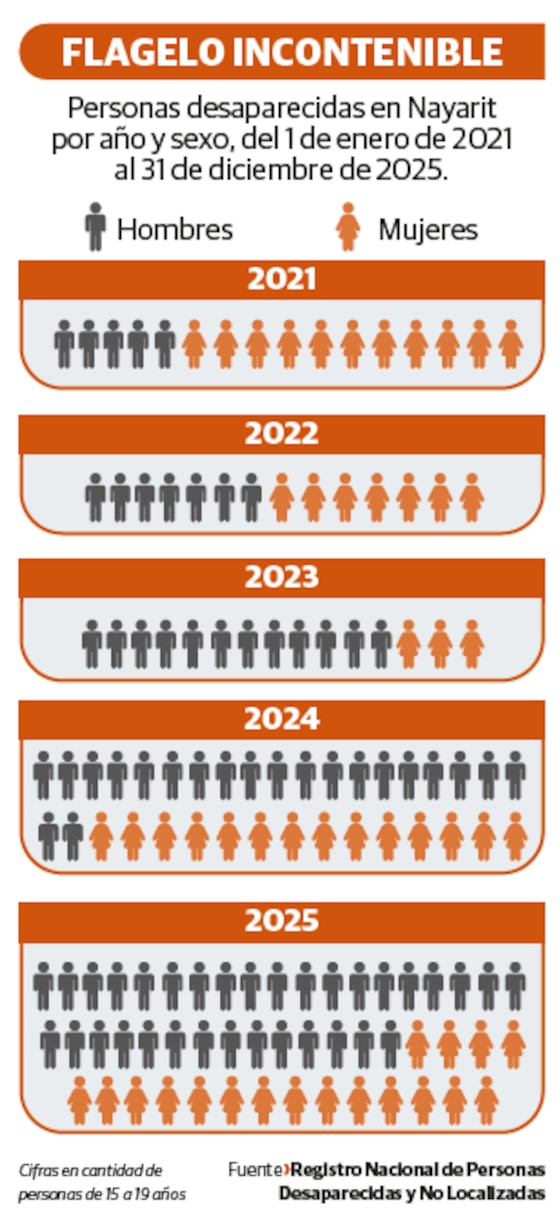
Cases of disappearances of young men between the ages of 15 and 19 in Nayarit increased almost sevenfold under Miguel Ángel Navarro Quintero, with five reported in the first year of his state government and the number skyrocketing to 33 in 2025.
For groups searching for missing persons, the situation is clear. When consulted by La Razón, they attributed this increase to the recruitment of underage boys by organized crime groups, specifically the Sinaloa Cartel, following the losses resulting from the ongoing dispute between two factions of that criminal group since the year before last.
Rosa María Jara Montes, leader of the Por Nuestros Corazones (For Our Hearts) collective, explained that the northern part of the state of Nayarit, bordering Sinaloa, is where the most cases of missing young men are being reported, forced to join the ranks of organized crime.
“We believe the disappearances are due to the turf war between the organized crime groups currently operating in the north of the state, and they are taking many young people, mainly men, although the number of missing women has also increased significantly; it is still mostly, let’s say 80 percent, men between the ages of 15 and 25,” she explained.
OLDER PEOPLE ARE ALSO AFFECTED. However, statistical details from the National Registry of Missing and Unlocated Persons (RNPDNO) indicate that the increase in these cases of young people between 15 and 19 years old is not the only one, as those in the 25-29 age range also saw an almost fivefold increase, with 8 reported in 2021 and 39 in 2025.
Similarly, Virginia Garay Cazares, leader of the collective Guerreras en Búsqueda de Nuestros Tesoros (Warriors in Search of Our Treasures), stated that the real number of missing persons is even higher and does not match the official registry figures, because many families do not report disappearances out of fear.
“They don’t report them because of fear and threats, because they have had to flee their homes. The situation is serious in the state of Nayarit,” she affirmed.
The activist pointed out that in the municipality of Huajicori there is a “very high” increase in disappearances, but not all have been reported due to fear, after being threatened.
Source: razon