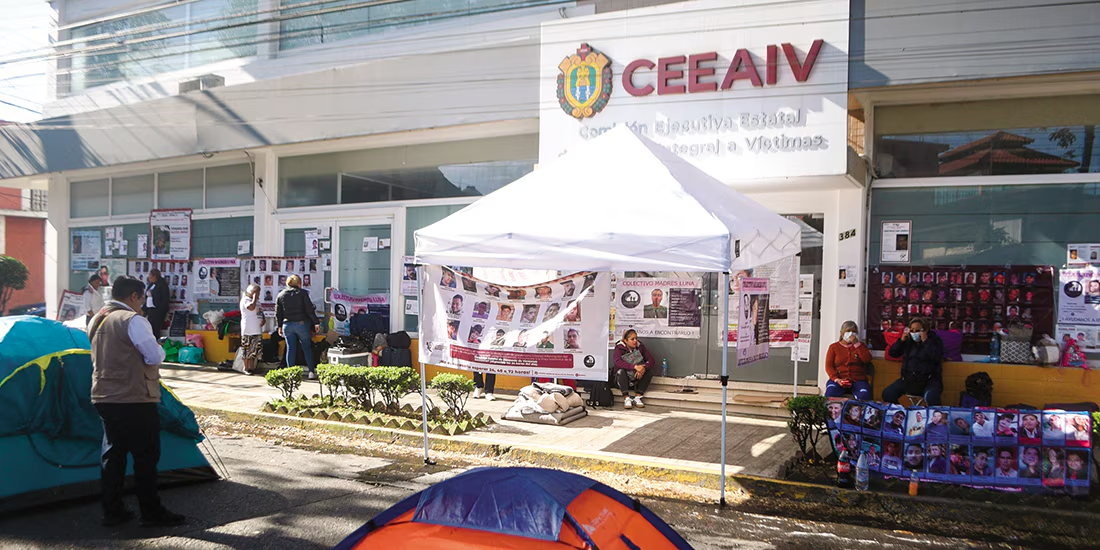

The reduction in homicides in Veracruz and Tabasco did not have an equivalent effect on another of the most serious forms of violence in the country: the disappearance of people. During the first half of 2026, the reduction in violent deaths in both states coincided with increases close to or greater than double in the number of people whose whereabouts remain unknown, according to an analysis by Causa en Común.
In the report What Official Crime Figures Say and Conceal in Mexico, the organization documents that Veracruz appears as one of the clearest cases in the six-month period. Murders decreased by one percent compared with January-June 2025, while disappearances increased by 116 percent.
- The Data: The report reveals that official figures showing a decline in crime in Mexico present extreme statistical anomalies and possible manipulation in state records.
The National Registry of Missing and Unlocated Persons (RNPDNO) recorded 212 cases during that period, a figure that places the state among those with the highest volume in the country over six months.
Another measurement makes it possible to observe how the problem is distributed throughout Veracruz. Red Lupa, a project of the Mexican Institute of Human Rights and Democracy (IMDHD) that analyzes official disappearance records, ranked the municipality of Veracruz 14th nationally for accumulated cases, with 1,067. Xalapa recorded 514 and Córdoba 294. The three municipalities account for 26 percent of the state’s records included in that exercise as of August 24.
- 21 percent is the national increase in missing persons
Tabasco shows an even greater contrast between both short-term trends. Causa en Común found that murders decreased by 37 percent compared with the first half of 2025, while disappearances increased by 96 percent. The registry used recorded 163 people who remained unlocated between January and June.
Red Lupa provides a different territorial snapshot because it works with accumulated cases and its own RNPDNO cutoffs, rather than only with new disappearances during the six-month period. In its most recent municipal review, Centro accounts for 862 missing persons, equivalent to 40 percent of the state’s records considered by the organization and enough to place the municipality 28th nationwide.
During the first half of 2026, Mexico recorded 4,784 missing persons and 9,305 murder victims, according to the Causa en Común analysis based on information from the Executive Secretariat of the National Public Security System and the RNPDNO.
Although the national balance continues to show more deaths than disappearances, the behavior in the state governed by Javier May shows cases in which the trends are reversed. The organization includes disappearances as an “opacity alert,” since the destination of the people remains unknown, and the statistics do not make it possible to accurately measure lethal violence.
México Evalúa documents that this separation between the behavior of homicides and disappearances has appeared between 2015 and the first half of 2026. Missing and unlocated persons increased by 127.3 percent, while intentional homicide decreased by 5.2 percent. The analysis argues that the latter crime “does not exhaust the measurement of violence” and proposes incorporating other indicators to evaluate its evolution.
Chiapas also showed a gap between both indicators. Between January and June, it recorded 212 disappearances and 195 murders. Compared with the same period in 2025, cases of people who remained unlocated increased by 61 percent, while deaths decreased by 11 percent.
Red Lupa’s accumulated review reinforces the growth observed in that state. Its records increased from 1,526 missing persons in 2025 to 2,005 by May 2026, an increase of more than 30 percent. Tapachula went from 204 to 280 cases in one year, while 63.9 percent of those who remain unlocated in the state were between 15 and 39 years old.
In Nayarit, disappearances far exceeded murders. Between January and June, the state recorded 153 missing persons compared with 37 murder victims. Compared with the same period in 2025, both indicators decreased, although the reduction was much greater in murders, at 61 percent, than in disappearances, at seven percent.
Red Lupa allows this case to be examined beyond the six-month period. Tepic went from 751 to 869 missing persons in one year and maintained the highest concentration as of May 16. The organization notes that 2025 was the year with the highest number of disappearances in Nayarit within its series and places the increase since 2017.
Causa en Común warns that its report does not claim that the reduction in homicides is explained by the increase in disappearances, nor does it equate the two phenomena. The warning is that, while thousands of people remain unlocated, part of the recorded violence remains without a definition that accurately reveals what happened to those victims.
Segob Defends Search Strategy and 4T Agenda
During her participation in Morena’s plenary meeting in the Chamber of Deputies, Secretary of the Interior (Segob) Rosa Icela Rodríguez highlighted coordination among federal institutions in the search for and location of missing persons and stated that President Claudia Sheinbaum’s government is working to guarantee the full exercise of rights.
Before Morena legislators, the federal official explained that personnel from the National Search Commission (CNB), the National Guard (GN), the Attorney General’s Office (FGR), and the Secretariat of Security and Citizen Protection (SSPC) participate in search efforts, with the aim of strengthening location operations.
She also stated that these efforts are part of the actions undertaken by the Government of Mexico to address one of the population’s main demands and ensure that institutions act jointly in response to cases of enforced disappearance.
The head of Segob highlighted the federal administration’s approval ratings and stated that public confidence in the government is above the average recorded among the countries of the Organisation for Economic Co-operation and Development (OECD).
Rodríguez Velázquez defended the administration’s political vision and maintained that public service should be oriented toward generating well-being, enforcing the popular will, and guaranteeing rights, rather than administering privileges. She also questioned the neoliberal model in which sectors of the population were marginalized.
Source: razon